The Magtel Foundation hosted a participatory
evaluation seminar on Tuesday last
Funded by the European Union, the Community
initiative seeks to improve the quality and effectiveness of humanitarian
action
The Magtel
Foundation is one of
the partners committed to support the
Erasmus+ project “KA2- Cooperation for Innovation and the Exchange of Good
Practices” (Innovation in Humanitarian Response: InovHumRe
2020-1-PT01-KA203-078796). Funded by the European Union, this initiative aims to improve the quality and effectiveness of
humanitarian action by improving training for students and
professionals within the field. To achieve this, a curricular unit on the assessment of humanitarian aid and the
development of learning tools will be launched.
Since NGOs
with experience in humanitarian response will jointly create the structure and
content of the curricular unit—including the learning tools and textbook—the
results will be based on work in the field and geared towards the learning
needs of both students and humanitarian professionals, i.e., NGOs.
The
partnership between universities and non-governmental organisations working to
promote the social inclusion of refugees and migrants ensures the involvement of stakeholders in the
development of materials. This will have an impact on the
requirements for successful inclusion of a group that faces serious risk of
segregation and discrimination.
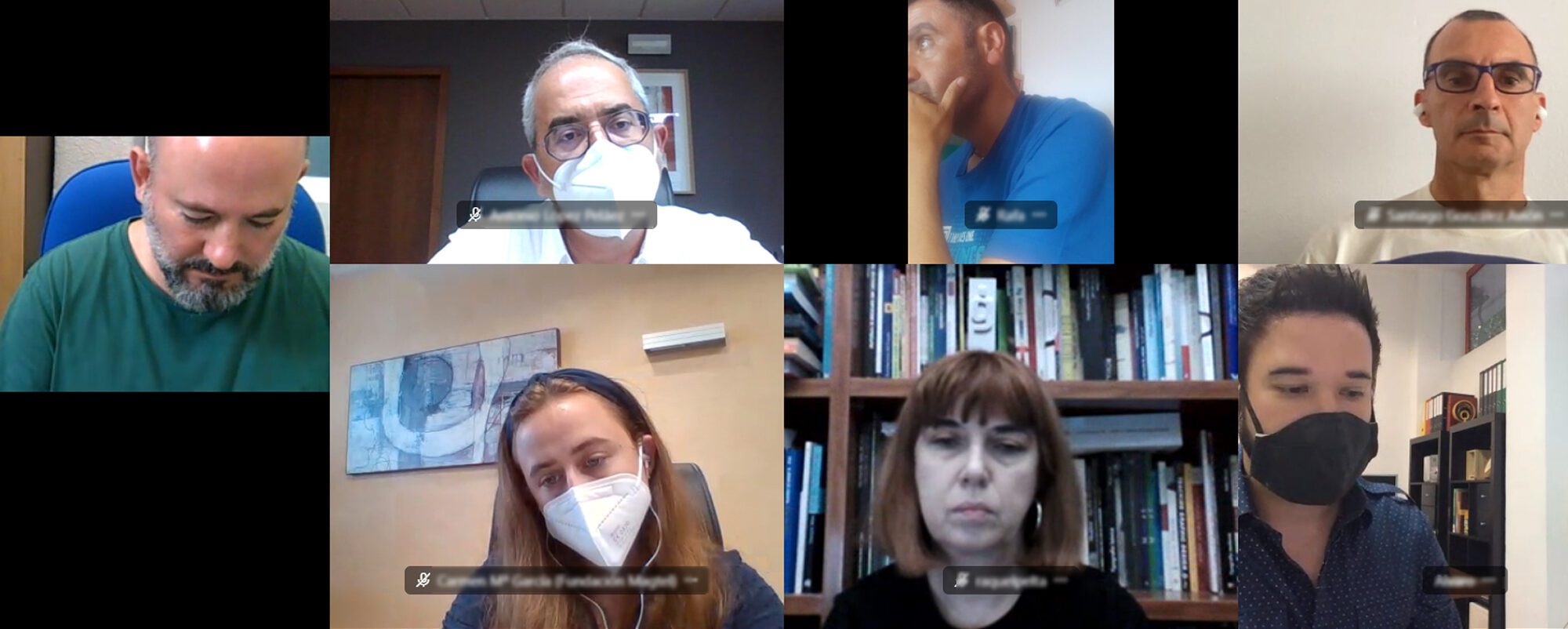
The participatory evaluation seminar was
hosted by the Magtel Foundation
at their Cordoba headquarters last Tuesday. This activity was organised within
the framework of the Erasmus+ project (KA2) and featured Rocío Ciero, the
coordinator of the seminar and the foundation’s project technician, as a
speaker. Antonio Lopez Pelaez, professor of Social Work and Social Services at
UNED (Spanish National University of Distance Education), presented the project
alongside Ciero, and together they outlined
the different NGO experiences in participatory evaluation.
This seminar,
along with the session organised for Thursday this week, serves as a working
session for the Spanish team and Spanish social organisations, allowing them to
“test the water” and establish a direct conversation with NGOs working in the
field of emergency humanitarian aid and/or care for refugees.
Yesterday,
Eduardo Garcia Carmona, a representative of the Prolibertas
Foundation in Cordoba; Santiago Gonzalez Avión, director of the Asociación
Diversidades [Diversity Association], and Alvaro Morcillo Soto, general
coordinator of the Asociación de Apoyo al Pueblo Sirio [Association for Support to the
Syrian People (AAPS), contributed their views and experiences to the
participatory evaluation.
Tomorrow,
Thursday 16 September, Raquel Pelta, lecturer in design research and history at
the University of Barcelona, will also appear. She will focus on participatory evaluation from the
perspective of co-design. Francisco Javier Garcia Castilla, lecturer
in Social Work at the National University of Distance Education (UNED), and
Angel de Juanas Oliva, lecturer in the Department of Education Theory and
Social Pedagogy within the Faculty of Education at UNED, will also explore
online methodologies for participatory evaluation.
To finish
off, there will be a round table discussion in which the contributions to the
project, from the Spanish experience, will be shared by the whole team.
The
seminars held in Cordoba on 14 and 16 September were made possible thanks to
the participation of 3 Spanish NGDOs. The
results of these discussions will be presented to other European project
partners in Ankara (Turkey) on 22 September by the
representatives of Turkey, Portugal, Colombia and Brazil.