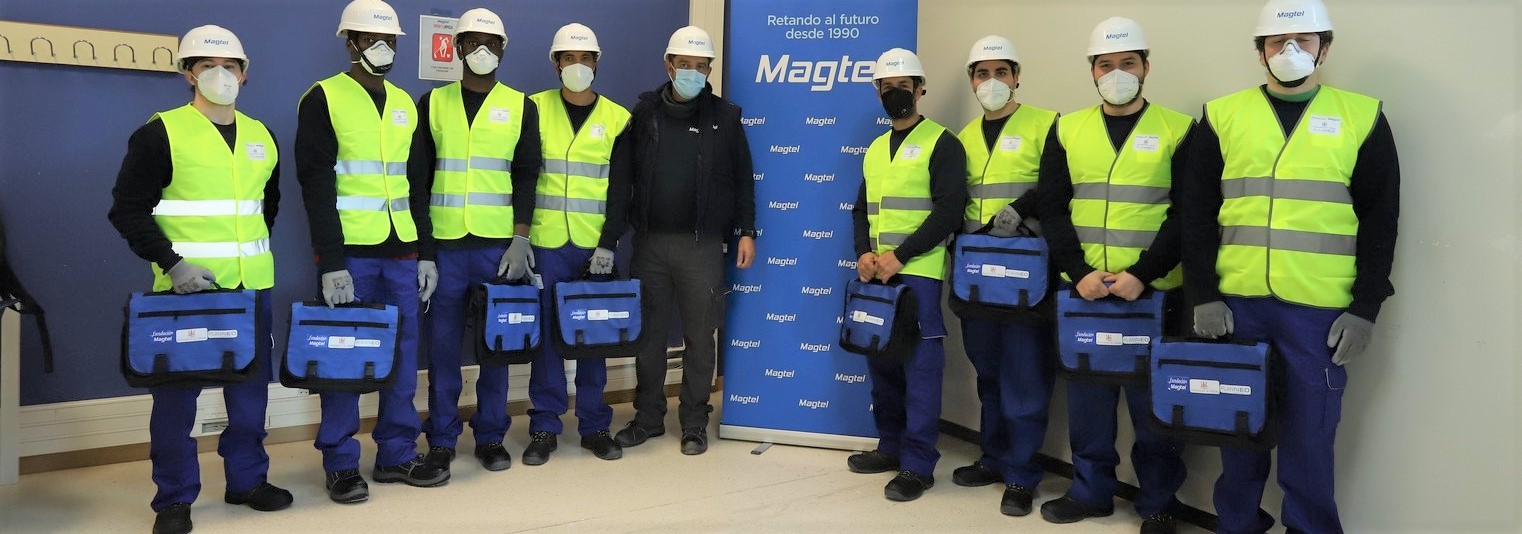
Fundación Magtel facilitates the preparation and distribution of food collected in the ‘Andaluces Compartiendo’ (Andalusians Sharing) campaign

The initiative promoted by Landaluz, Fundación Cajasol and Fundación La Caixa has collected a total of 225,000 kilos of food products

Once again this year, the Fundación Magtel provided the necessary logistical support for the distribution and delivery of the food collected in the campaign “Andaluces Compartiendo” (Andalusians Sharing) campaign, part of the Corporate Social Responsibility programme promoted by the  Landaluz, Fundación Cajasol and Fundación La Caixa.

The initiative has brought together more than 20 companies to provide families with a range of basic necessities such as oil, milk, canned fish, canned vegetables, pulses, etc. The total amount of food collected in this campaign amounts to 225.000 kilos and will be delivered to more than 210 social organisations in the provinces of Cordoba, Cadiz, Huelva and Seville.

In this sense, Fundación Magtel has provided its facilities in the industrial estate of Las Quemadas  storage of the products. From this location, the pallets of food received have been distributed to the different local entities that will benefit from this campaign.

Non-profit associations in charge of local food distribution include: Obra Social “Hermano Bonifacio” Hospital San Juan de Dios de Córdoba; Córdoba Acoge; Fundación Prolibertas-Comedor Social Trinitarios; Mujeres en Zona de Conflicto; Centro de Servicio Caritativo “Buenas Noticias”; Fundación Cruz Blanca; Comunidad Adoratrices de Córdoba; Asociación Iemakaie; Cáritas Parroquial San Lorenzo Mártir de Córdoba and Cáritas Parroquial Trinitarios.

Alleviating the current social ramifications

Andaluces Compartiendo is a solidarity programme organised by the Landaluz Association which, since its beginnings in 2013 to date, has become a global brand of Corporate Social Responsibility for different Andalusian companies, where the organisations that make up the association are committed to values such as commitment and unity.

This action is part of the Andaluces Compartiendo donation campaign at regional level, which allows food to be delivered through business organisations in Andalusia, with the aim of reducing the current social and economic ramifications of the food crisis.

The Alliance for an Inclusive Energy Transition adds Fundación Magtel as a new associate member

The initiative develops solutions to the labour and social problems of vulnerable groups

Fundación Magtel has joined the Alliance for an Inclusive Energy Transition promoted by  Fundación Repsol and Fundación Santa María la Real through its Employment and Social Inclusion Area. It is the first multi-agent network that is committed to the energy transition as an opportunity to develop solutions to the employment and social problems of vulnerable groups.

To this end, the Alliance plans to develop a range of employment and training programmes to boost employability. In addition to Fundación Magtel, the rest of the members can access the results of these experimental programmes in order to carry out other training actions.

The participants, who come from more than 70 entities, maintain a social approach as a value proposition for the training and updating of professionals in the context of the energy transition.

The Alliance for an Inclusive Energy Transition also consists of an important network of allies and key actors who pool their resources to achieve common goals, improving the pattern of action and creating synergies.

Cordoba City Council Youth Delegation completes FTTH training programme in collaboration with the Magtel Foundation

This free course is intended for unemployed young people between the ages of 18 and 35

The Magtel Foundation has completed a training programme on the installation of fibre-to-the-home (FTTH), promoted by the Youth Delegation of the City of Cordoba. As part of this programme, students have learnt how to install this type of fibre optic in homes.

The course was held between November 29 and December 30, and within the framework of the Planneo Cualifica Programme.

This course is aimed at young people between the ages of 18 and 35 who are either native to or residents of this region of Andalusia. Broadly speaking, it is an opportunity for participants to acquire further education and increase their employment prospects.

The Magtel Foundation has expertise and experience in organising training courses related to telecommunications, and the organisation teaches numerous courses throughout the year.

Training targeted at vulnerable groups

The programmes promoted by Planneo Cualifica aim to provide quality training content in emerging niches of employment, as is the case with the course offered by the Magtel Foundation; offer quality training through specific courses and workshops; improve the employability of vulnerable groups and encourage young people in vulnerable neighbourhoods to develop the skills they need to ensure their full inclusion.

El delegado de Empleo de la Junta de Andalucía en Córdoba, Ángel Herrador, visita el proyecto Terapiam de Fundación Magtel

La institución desarrolla ‘Terapiam 3.0’ gracias a un proyecto de Interés General y Social de la Consejería de Empleo que ha insertado a cinco personas

El delegado de Empleo, Formación, Trabajo Autónomo, Economía, Conocimiento, Empresas y Universidad, Ángel Herrador, ha visitado esta mañana la empresa Magtel para mantener un encuentro con las personas contratadas gracias al proyecto de Interés General y Social, IGS, denominado ‘Terapiam 3.0’ que Fundación Magtel ha desarrollado durante siete meses y en la que participaron 8 desempleados. El responsable territorial ha estado acompañado por la presidenta de Fundación Magtel, Auxiliadora López.

Herrador ha querido agradecer la predisposición y colaboración con iniciativas de este tipo “que aúnan para mejorar la empleabilidad de las personas con la búsqueda de soluciones en diferentes ámbitos y que pueden transformarse en generación de empleo, traduciéndose en proyectos sólidos, reales y de futuro”.

El delegado de Empleo ha puesto de manifiesto no solo la importancia de conseguir la inserción laboral de los participantes, “la iniciativa ha permitido la contratación de 8 personas durante siete meses y esta empresa ha contratado a cinco de estos participantes”, sino en los sectores donde se ha desarrollado su actividad, “los participantes han trabajado en el ámbito de ingenierías de telecomunicaciones, industria e informática, terapia ocupacional, trabajo social, administración empresas y programación de aplicaciones informáticas, profesiones sin duda con mucho futuro”.

Por su parte la presidenta de Fundación Magtel ha agradecido el apoyo de la Administración en este proyecto y ha destacado que “gracias a los programas de empleabilidad de Fundación Magtel contribuimos a la generación de oportunidades laborales para personas desempleadas.” Además, Auxiliadora López ha resaltado que “los proyectos de innovación social que se desarrollan en Fundación Magtel favorecen la calidad de vida de personas con discapacidad y en situación de dependencia.”

Un proyecto en constante evolución

TERAPIAM nació en 2015 fruto de la iniciativa de Fundación Magtel y la División de I+D+i de Magtel. En su fase inicial fue considerada como Proyecto de Interés General y Social Generador de Empleo por la Junta de Andalucía.

Este sistema funciona como herramienta complementaria de apoyo a los profesionales Terapeutas Ocupacionales / Fisioterapeutas, a través de un entorno virtual terapéutico más dinámico y en consonancia con nuevas tecnologías innovadoras adaptadas al ámbito social.

La evolución de Terapiam se ha dirigido hacia entornos 3D. De este modo, mediante una experiencia lúdica y virtual, la persona usuaria se ve inmersa en escenarios de realidad virtual siendo protagonista de su terapia de forma autónoma, al tiempo que es orientada por su profesional de referencia.

Con esto se persiguen tres fines fundamentales: Investigar nuevas herramientas complementarias que puedan ser incorporadas al sistema actual de TERAPIAM y permitan evolucionarlo; adaptar todas las terapias, sesiones, espacios y escenarios ya desarrollados en 2D a 3D, y seguir dotando a las personas terapeutas de herramientas de innovación tecnológica que les permita seguir motivando a sus personas usuarias para la prevención de su movilidad física y mantenimiento cognitivo.

The Magtel Foundation fosters eco-friendly agriculture among the Cedropampa (Peru) community to boost its socioeconomic development

The project’s goal is to increase the income of 50 families by expanding agricultural production and subsequently selling the products


The Magtel Foundation is working on a project to improve water management and to increase agricultural production in Peru’s Cedropampa community. The aim of this initiative is to raise the income of 50 families in the community, currently in extreme poverty, by promoting eco-friendly agriculture and associativism, and improving product commercialization.

The project was launched last December to create a new irrigation system that includes installing an artificial water storage well and building irrigation canals on the communal land. It will also involve working with Cedropampa residents on how to use and maintain this new infrastructure, along with agricultural training.

Additional plans include encouraging locals to plant and restore traditional crops, such as native potato varieties, by using natural compost to improve soil fertility. Thanks to this project, Cedropampa residents will be able to harvest twice yearly as opposed to only once per year.

With this initiative, the Magtel Foundation strives to implement sustainable and environmentally friendly practices that support the socioeconomic development of this community, one of the poorest in the nation. In this sense, the project works on promoting associativismwomen’s empowerment and a stronger commercialization network that will help farmers receive fair prices for their products.

Cedropampa community

This community belongs to the Salcabamba district and is located between the Western and Eastern Ranges of the Andes Mountains, in Peru’s central region. According to the latest census, it is made up of 50 families with limited resources and without access to basic services such as a public water system. However, Cedropampa has a significant amount of water resources and extensive farmland for agriculture.

The project will assist these families, with a special focus on women and girls in light of the discrimination they frequently face. For its execution, the project has a team of professionals who speak Quechua, the residents’ mother tongue, making it easier to communicate and respect the cultural diversity.

Participating entities

The initiative is funded by the Cordoba Provincial Council and backed by the Magtel Foundation, which provides the technical consulting needed to manage and execute the project, along with the experience obtained in similar water cycle management projects. The local counterparts in Peru include the Proyecto Solidario por la Infancia and the Salcabamba municipality as the local partner to which Cedropampa residents belong.

A participatory project

The project’s design has had a strong participatory nature because it resulted from a preliminary analysis performed by the entities involved, in which Cedropampa’s residents expressed their needs and proposed solutions. The main issues it aims to address are the limited resources among families, the minimal involvement of women in the community’s local development and the insufficient access to water for irrigation purposes.

This project is an extension of the work started in 2016 in Cedropampa, also in conjunction with the Cordoba Provincial Council. That project made it possible to create an Irrigation Committee and train 30 mothers. The second phase aimed at improving the irrigation, production and commercialization systems remained pending, although it is currently underway.


The Teleasistenci@TIC++ project created by the Magtel Foundation and Magtel’s R&D&i division strives to improve the quality of life of senior citizens and dependents

The President of the Instituto Municipal de Desarrollo Económico y Empleo (Municipal Institute for Economic Development and Employment), Mar Téllez, visited the Magtel Foundation today to learn how the platform operates

The Magtel Foundation is developing Teleasistenci@TIC++ in collaboration with Magtel’s R&D&i division. The project’s goal is to assist senior citizens and dependents through the use of information and communications technology (ICT).

Specifically, this initiative involves designing and launching a website platform and mobile app to handle emergencies and streamline Active Participation Centers for Senior Citizens (APC). It enables users to self-manage their remote assistance needs and use the various features, such as sending notifications to family members or confirming enrollment in APC activities, among other aspects.

Teleasistenci@TIC++ is backed by the Instituto Municipal de Desarrollo Económico y Empleo (Municipal Institute for Economic Development and Employment of Córdoba, IMDEEC), whose president, Mar Téllez, visited the Magtel Foundation today to learn how the platform operates. This support, through its Annual Call for Subsidies for Non-Profit Entities, has made it possible to hire a computer engineer so as to continue working on developing this tool.

During the project’s presentation for the president of IMDEEC, the Director of the Magtel Foundation, Adrián Fernández, stressed the entity’s firm commitment “towards addressing the needs of disadvantaged groups by applying technology and innovation.

On her behalf, Téllez pointed out that “Teleasistenci@tic++ is an excellent example of how innovative entrepreneurship can improve people’s quality of life by leveraging the potential of new technologies to help care for dependents in their own home.”

With this project, the Magtel Foundation is working to supplement traditional remote assistance services by offering the possibility to perform routine tasks with normalcy, inside and outside a user’s home, facilitating two-way communication between users and the Active Participation Centers (APC). Through Teleasistenci@TIC++, the entity promotes the active aging concept, improves the quality of life of senior citizens and dependents, and encourages personal autonomy.

Teleasistenci@TIC++ is being developed by the Magtel Foundation as the next phase of Teleasistenci@TIC+, a project backed by the Regional Government of Andalusia’s Department of Equality, Health and Social Policies, and submitted with the aim of reducing the “technology gap” between senior citizens and dependents.

More than 80 people with disabilities have undergone rehabilitation and physical therapy sessions using augmented reality techniques.

The TERAPIAM project developed by the Magtel Foundation has completed more than 1,100 sessions to support the work of therapists and physical therapists.

More than 80 people with disabilities have undergone rehabilitation and physical therapy sessions through the TERAPIAM interactive program. This initiative uses augmented reality techniques and a motion capture system to improve the autonomy of people with physical and intellectual disabilities.

Specifically, TERAPIAM enables therapists and physical therapists to perform their regular work by completing rehabilitation sessions using this technological device. It places users in an entertaining setting, similar to that of a video game, and using an avatar, they become the protagonist of their own therapy.

This program has scheduled more than 1,100 sessions involving the 18 activities available in TERAPIAM. Through the use of numbers, colors and sounds, participants complete the exercises and repetitions specified in their rehabilitation treatment.

This increases the user’s motivationconcentration and level of effort. In fact, based on the results obtained, the level at which users perform routines improves in terms of the score obtained and the times required as the sessions progress.

TERAPIAM is geared towards people with functional physical and intellectual diversity who are over the age of six, as well as older segments. Its aim is to improve physical conditioning, cognitive stimulation and, overall, encourage personal autonomy.

This project is funded by the Regional Government of Andalusia’s Department of Equality and Social Policies as part of the call covered by the 0.7% personal income tax allocation. It was developed in coordination with Codisa-Predif and Fepamic, where the TERAPIAM device was installed and worked on with users over the last four months.

During the results presentation, the Director of the Magtel Foundation, Adrián Fernández, highlighted the entity’s commitment “to social innovation and using technology to improve the quality of life for people with disabilities.” On her behalf, the Delegate for Equality, Health and Social Policies pointed out that “all the resources are important, so with the goal of encouraging personal autonomy, the Regional Government of Andalusia supports any initiative that helps to build a better and more equal society.

A constantly evolving project

TERAPIAM was created in 2016 by the Magtel Foundation and Magtel’s R&D&i division. During the initial phase, it was classified as a General Interest Project that Fosters Social Job Creation by the Regional Government of Andalusia, leading the Magtel Foundation to hire a multidisciplinary team of ten qualified professionals with knowledge of unemployment.

Throughout its execution, it has been backed by three Córdoba associations that work with people with disabilities—Asociación Cordobesa de Parálisis Cerebral (ACPACYS, Córdoba Cerebral Palsy Association), Asociación de Parkinson de Córdoba (APARCOR, Córdoba Parkinson’s Association) and Asociación Cordobesa de Esclerosis Múltiple (ACODEM, Córdoba Multiple Sclerosis Association)—and supported by the Instituto Municipal de Desarrollo Económico y Empleo de Córdoba (IMDEEC, Córdoba Municipal Institute for Economic Development and Employment).

TERAPIAM is continuously evolving and improving with new features that make it possible to adapt the proposed routines and activities to user needs.

The Magtel Foundation participates in a project to improve the crop and irrigation systems for the Cedropampa community in Peru

The initiative financed by the Cordoba Provincial Council is the result of a partnership between the Posadas City Government, the Proyecto Solidario por la Infancia – Peru and the Salcabamba municipality.

The Magtel Foundation is participating in a project to improve the crop systems used in Peru’s Cedropampa community. The aim is to provide 15 families with the necessary equipment and training to install a sprinkler irrigation system in their small agricultural operations.

Thanks to this initiative, Cedropampa residents will be able to increase production by harvesting twice yearly as opposed to only once per year. This will enable members to earn more money, thereby lowering the social exclusion levels of this village, one of the poorest in the Andean nation.

The planned actions are aligned with the community’s traditional practices and the Andean world view promoted by the harmonious and positive relationship between nature, humans and Mother Earth. As part of this project, efforts are made to train farmers, use natural compost and restore traditional crops.

Additionally, the “Cedropampa Irrigation Committee” was created by the community’s Quechua women. This community organization is backed by the Salcabamba municipality. Female participants are receiving training and technical assistance on how to manage and maintain the irrigation systems, as well as on the efficient use of water. This strengthens the social and active presence of women in rural areas along with their role in local governance, and it also helps reduce gender inequality.

Cedropampa community

Cedropampa belongs to the Salcabamba district and is located between the Western and Eastern Ranges of the Andes Mountains, in Peru’s central region. According to the 2007 census, this village is made up of approximately 100 families with limited resources and without access to basic services such as a public water system. However, Cedropampa has a significant amount of water resources and extensive farmland for agriculture that require a project of this type to optimize their use.

The project gave priority to 15 indigenous families, with a special focus on women and girls in light of the discrimination they frequently face. Additionally, there was always a team of professionals who speak Quechua, the residents’ mother tongue, making it easier to communicate and respect the cultural diversity.

Participating entities

The project to improve shared water use is the result of efforts by the Posadas City Government and the Magtel Foundation. The local partners in Peru are the Proyecto Solidario por la Infancia and the Salcabamba municipality to which Cedropampa residents belong. Funding is provided by the Cordoba Provincial Council as part of its 2016 call for International Cooperation for Development.

The Magtel Foundation provides the technical consulting needed for the project’s management and execution, along with the experience obtained by its parent company, Magtel, in similar water cycle management projects.

Preliminary analysis

The joint effort of the Spanish and Peruvian entities resulted in a preliminary analysis of the situation. The main issues identified were the limited resources among families, the minimal involvement of women in the community’s local development and the insufficient access to water for irrigation purposes.

Using this analysis, a project was designed that would address these needs, taking into consideration the proposals received from the Salcabamba community, which was actively involved in the project, and from the participating public and private institutions.